
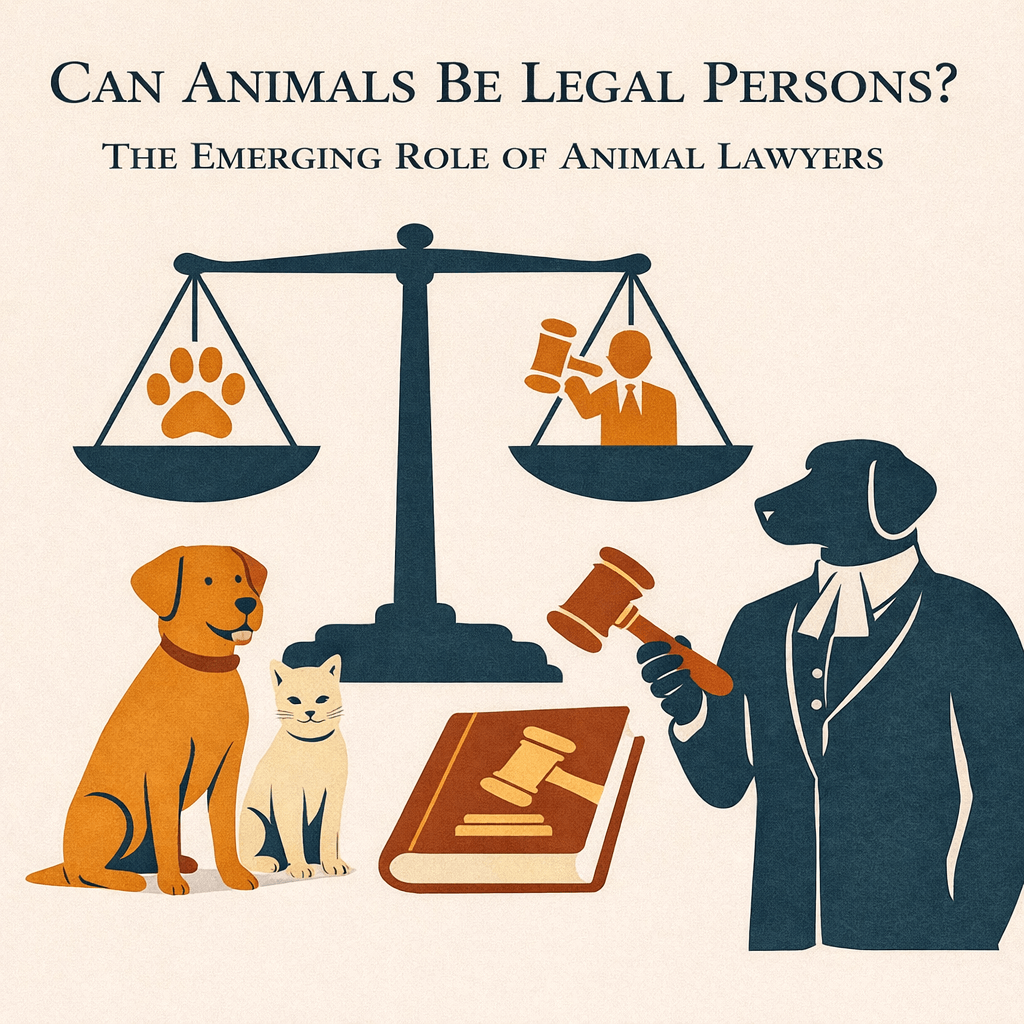
INTRODUCTION
For centuries, animals have been treated as property, owned, traded, used, and even killed without any real legal consequences. But modern jurisprudence has started asking a bold question:
Should animals have legal rights of their own?
And if so, will we soon need animal lawyers?
A legal person is an entity recognised by the law as having rights and duties. Interestingly, companies, trusts, idols, and even rivers have already been granted the status of a legal person. If non-living entities already receive legal recognition, then why not living, sentient beings who undoubtedly feel pain, fear, and attachment? That is the core of this debate.
It lies at the juncture of law, ethics, philosophy, and environmental protection, thus becoming one of the most relevant emerging areas in legal studies today.
WHAT IS LEGAL PERSONHOOD?
The term “legal person” does not refer solely to a human. It is an entity that the law recognises as possessing rights and duties. Example:
- Companies can purchase property and sue other companies.
- Temples and trusts can hold land.
- The Indian Constitution grants certain rights to rivers in some states.
Yet animals, although they live, are denied legal personhood. They are treated as objects — movable property. This leads to a contradiction in the legal system; How can a lifeless company hold more legal protection than a living animal?
Legal personhood does not mean granting animals the status of humans; rather, it means recognising them as “right-bearing beings.”[1]
GLOBAL JUDICIAL APPROACH
Argentina – The Orangutan Case: In 2015, a Buenos Aires court declared an orangutan named Sandra a “non-human person” with basic rights. She was shifted from a zoo to a sanctuary.[2] It was the first time a court recognised an animal’s rights using habeas corpus, a remedy normally reserved for humans.
United States: The Nonhuman Rights Project has filed petitions for chimpanzees like Tommy and Kiko, arguing that their intelligence deserves legal consideration.[3] Although courts did not grant full personhood, judges admitted that the debate is morally and scientifically significant.
New Zealand – Rights of Nature: In 2017, the Whanganui River was declared a legal person and two guardians were appointed to protect its interests.[4] While this was not about animals, it did demonstrate how the law is expanding its protection to include non-humans.
These cases make one thing very clear: It is not just humans who are afforded legal personhood anymore.
INDIAN POSITION A SILENT REVOLUTION
There have been significant legal developments in India:
Animal Cruelty Laws Exist -But Are Weak: While the Prevention of Cruelty to Animals Act, 1960 prohibit cruelty under Section 11, the maximum punishment is often only a fine of ₹50 to 100. Such penalties do not match the seriousness of abuse.
Jallikattu & Cultural Debate: The Supreme Court banned the Jallikattu, a bull taming event, in Animal Welfare Board of India vs. A. Nagaraja, 2014, on the grounds of cruelty to animals.[5] Later Tamil Nadu passed legislation to protect it as a culture. In this case, culture and animal rights were in conflict.
Personhood under Indian Law: A serious paradigm shift started happening in India with courts starting to recognise animals as much more than property. In 2018, a division bench of the Uttarakhand High Court passed an order stating that all animals are legal persons and thus entitled to rights under the law; it said humans were merely acting as their parents or guardians rather than owners[6]. This became a hallmark moment in Indian jurisprudence because it gave animals a certain status within the rights paradigm instead of being mere objects. In support of this, the Punjab and Haryana High Court also developed the argument in 2019 to firmly confirm that animals have a distinct legal entity different from other forms of movable property, opening up their possible representation in courts and their protection under the constitutional ethos. These judgments do not give a structured legal jurisprudence as yet, but certainly point to a direction in which Indian jurisprudence on animals is heading toward — personhood, guardianship, and enforceable rights.
DO ANIMALS NEED LAWYERS?
In case legal personhood becomes commonplace, animals will require their legal representation, similar to that of minors or mentally unfit persons, through guardians.
That could lead to:
- Court-Appointed Representatives for Street Dogs and Captive Animals.
- Legal audits of factory farms, circuses, and zoos.
- Expanded PILs on animal welfare.
- A new specialised field: Animal Rights Litigation.
- Law students these days may soon become animal lawyers, representing those who cannot speak for themselves.
LEGAL AND ETHICAL CHALLENGES
Recognising animals as legal persons raises difficult practical questions. The first challenge is that of representation-if animals are conferred rights, who represents them in courts? NGOs, state-appointed guardians, or individual citizens?
There also needs to be clarity over the scope of rights that are accorded. Do animals need basic rights-related protection regarding their food, shelter and safety, or do they have a claim to wider freedoms related to movement, psychological well-being and protection from captivity?
The questions that emerge show that when it comes to legal personhood, what is required is much more than a declaration; it calls for an articulated system for enforcement and representation.
The conflict between animal rights and economic interests due to the heavy reliance of industries on animal use, such as dairy, meat, cosmetics testing, circuses, and entertainment, is another huge concern. Strong legal rights could create resistance from these sectors. Enforcement remains an issue with laws in place, but cruelty to animals continues daily in homes, on the streets, in farms and in marketplaces.
Even more complicated is the issue of consent: since animals cannot directly express their choices, how do we ascertain their interest? Ethical and practical questions such as these must be accounted for prior to meaningful legal implementation of animal personhood.
THE FUTURE OF ANIMAL RIGHTS LAW
What could happen over the next few decades?
- Welfare officers may be appointed in the courts.
- Legal audits may be required for zoos and farms.
- Legal personhood for endangered species.
- Compulsory legal representatives for trafficked animals.
Animal cruelty may become a serious criminal offence and not just a fine. Ultimately, the question is not one of making animals equal to humans; it’s one of respect for sentience. If a company can have legal rights, a living being surely deserves at least humane protection.
CONCLUSION
Giving animals legal personhood is not about humanising animals; it’s about humanising humans. Modern law is moving from “animal welfare” to animal justice. And justice needs a voice even for those who cannot speak.
One day, lawyers may walk into court not just for clients, but for creatures.
Not for profit — but for life.
The question is no longer “Can animals think?”
The real question is — “Can humans feel?
Author’s Name: Ayush Gupta (IILM University, School of Law)
[1] Legal personhood is a concept in jurisprudence where the law treats an entity as possessing rights and duties.
[2] Sandra the orangutan case, Buenos Aires Court (2015).
[3] Nonhuman Rights Project, New York Court filings (2013–2019).
[4] New Zealand’s Te Awa Tupua (Whanganui River Claims Settlement) Act, 2017.
[5] Animal Welfare Board of India vs. A. Nagaraja (2014), Supreme Court of India
[6] Uttarakhand HC (2018) and Punjab & Haryana HC (2019) rulings on animal personhood.
