
INTRODUCTION
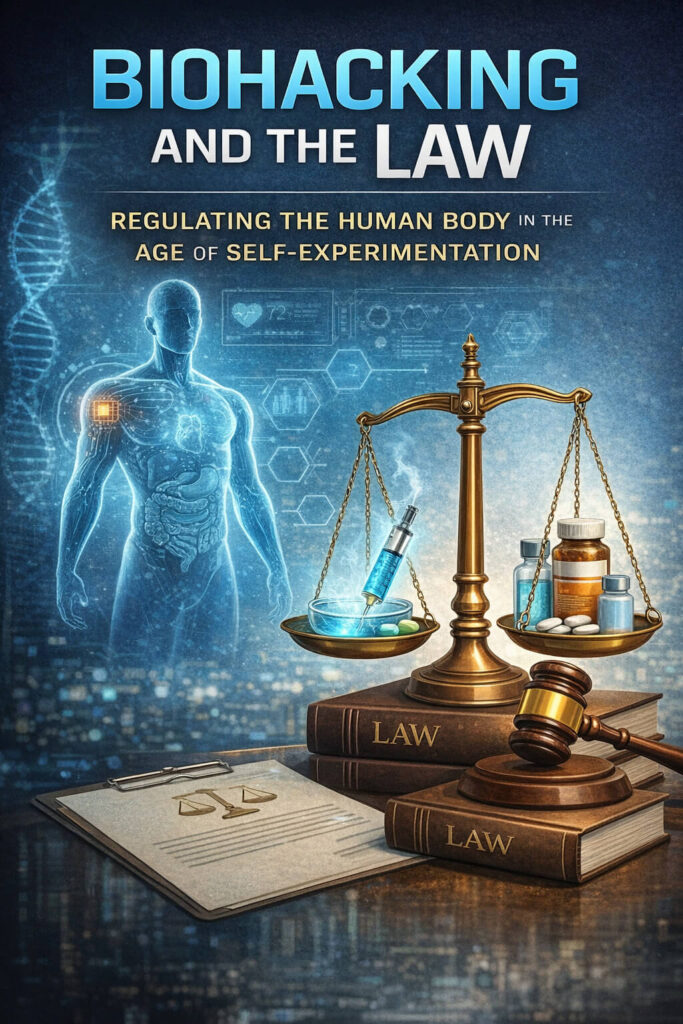
For centuries, the human body was viewed as something to be healed only within the boundaries of traditional medicine. Doctors diagnosed, hospitals treated, and patients complied. Today, that relationship is changing. A growing global movement known as biohacking encourages individuals to take biological enhancement into their own hands. From wearable implants and neural stimulation to genetic self‑experimentation, biohacking challenges how law understands medicine, autonomy, and risk. While biohacking promises innovation and empowerment, it also raises difficult legal questions. Existing legal frameworks were designed for institutional medicine, not for individuals modifying their own biology at home. This blog examines biohacking through a legal lens, focusing on regulation, rights, liability, and ethical concerns.
UNDERSTANDING BIOHACKING
Biohacking refers to practices through which individuals seek to optimise physical or cognitive performance using science and technology. Some practices, such as dietary modification or fitness tracking, are relatively low risk. Others involve invasive procedures, such as implanting microchips or experimenting with gene‑editing tools outside formal laboratories.[1] These activities often occur without medical supervision, placing them outside traditional regulatory systems.
LEGAL FRAMEWORKS AND REGULATORY GAPS
Medical law traditionally relies on the doctor–patient relationship. Concepts such as informed consent and professional negligence presuppose institutional oversight. Biohacking disrupts this model. When individuals experiment on themselves, there may be no recognised practitioner and no ethical review.[2] Similarly, drug and device regulation struggles to address biohacking. Many products are marketed as wellness tools to avoid regulatory scrutiny, while DIY genetic kits operate in a legal grey area.[3]
FUNDAMENTAL RIGHTS AND PUBLIC HEALTH
Biohackers often rely on bodily autonomy, arguing that individuals should control what happens to their own bodies. Liberal legal systems recognise this freedom, including the right to refuse medical treatment.[4] However, autonomy is not absolute. Where biohacking poses risks to public health, the state has a legitimate interest in regulation. Genetic self‑experimentation, in particular, raises concerns about unintended consequences beyond the individual.[5]
LIABILITY AND ACCOUNTABILITY
Liability in biohacking cases is unclear. Self‑harm may not give rise to claims, but issues arise when third parties are involved, such as manufacturers of kits or informal practitioners. Product liability law may apply, but causation is difficult to establish.[6] Criminal liability may arise where biohacking violates biosafety or drug control laws, though enforcement remains inconsistent.
NATIONAL APPROACHES
In the United States, regulation is fragmented. The FDA has issued warnings but has not comprehensively regulated self‑experimentation.[7] The European Union adopts a more precautionary approach, particularly in relation to genetic modification.[8] India relies primarily on ethical guidelines issued by the Indian Council of Medical Research, which focus on institutional research. As biohacking grows, scholars argue that India must clarify legal boundaries.[9]
CONCLUSION
Biohacking reflects a changing relationship between human beings and their own bodies. What was once shaped largely by doctors, hospitals, and regulated medical systems is now increasingly influenced by individual choice, curiosity, and access to technology. People are no longer content to wait for institutional approval; many want to experiment, enhance, and understand their biology on their own terms. This shift does not merely bring the law into unfamiliar territory. Legal frameworks governing medicine and biomedical research were built around professional oversight and clear technological.
Biohacking disrupts these assumptions. When individuals experiment on themselves, often outside formal settings, traditional concepts such as informed consent, medical negligence, and ethical review begin to lose their clarity. The law struggles not because biohacking is inherently unlawful, but because it does not fit neatly within existing legal categories.
At the same time, absolute freedom over one’s body is neither realistic nor desirable. The consequences of biological experimentation do not always remain personal. Unregulated use of genetic tools, hormones, or biomedical devices can create risks that extend beyond the individual, affecting public health and safety. The challenge for law, therefore, lies in recognising personal autonomy while still acknowledging its limits. Regulation in this context should not be driven by fear or moral panic, but by a careful assessment of risk, responsibility, and social impact.
Biohacking also raises quieter but equally important ethical concerns. Access to enhancement technologies may deepen social inequalities, allowing those with resources to improve themselves while others are left behind. There is also the risk of commercial exploitation, where unverified products are marketed to individuals seeking quick solutions to complex biological problems. Without legal guidance, the promise of empowerment can easily turn into vulnerability.
Looking ahead, the legal response to biohacking must be flexible, informed, and humane. Rather than attempting to ban self-experimentation altogether, the law should aim to draw sensible boundaries, encouraging low-risk personal practices while regulating activities that pose serious harm. Education, transparency, and adaptive regulation will be just as important as enforcement.
Ultimately, biohacking forces us to confront a fundamental question: how should the law respond when humans begin to redesign themselves? The answer lies not in resisting change, but in shaping it responsibly. As science moves closer to the body, the law must remain grounded in its most enduring purpose to protect human dignity, even as the meaning of being human continues to evolve.
Biohacking ultimately compels the law to respond to a deeply personal form of innovation. It challenges legal systems to move beyond rigid categories and engage with how people actually live, experiment, and seek improvement. Regulation should not be driven by fear of the unfamiliar, but by an understanding of risk, responsibility, and human dignity. As technology moves closer to the body, the law must remain attentive, adaptive, and compassionate. Its role is not to halt progress, but to ensure that the pursuit of enhancement does not come at the cost of safety, equity, or the fundamental values that law exists to protect.
Author’s Name: Ashutosh Mishra (Indore Institute of Law, Indore)
[1] Tim Ferriss, Tools of Titans (Houghton Mifflin Harcourt 2016).
[2] Margaret Somerville, The Ethical Canary (Penguin 2000).
[3] Federal Food, Drug, and Cosmetic Act 1938, 21 USC §301.
[4] Airedale NHS Trust v Bland [1993] AC 789 (HL).
[5] National Academies of Sciences, Human Genome Editing (National Academies Press, 2017).
[6] Donal Nolan, ‘Product Liability and Emerging Technologies’ (2020) 79 CLJ 88.
[7] FDA, ‘Statement on DIY Gene Therapy’ (2017).
[8] Regulation (EU) 2017/745.
[9] ICMR, National Ethical Guidelines for Biomedical Research (2017).
