
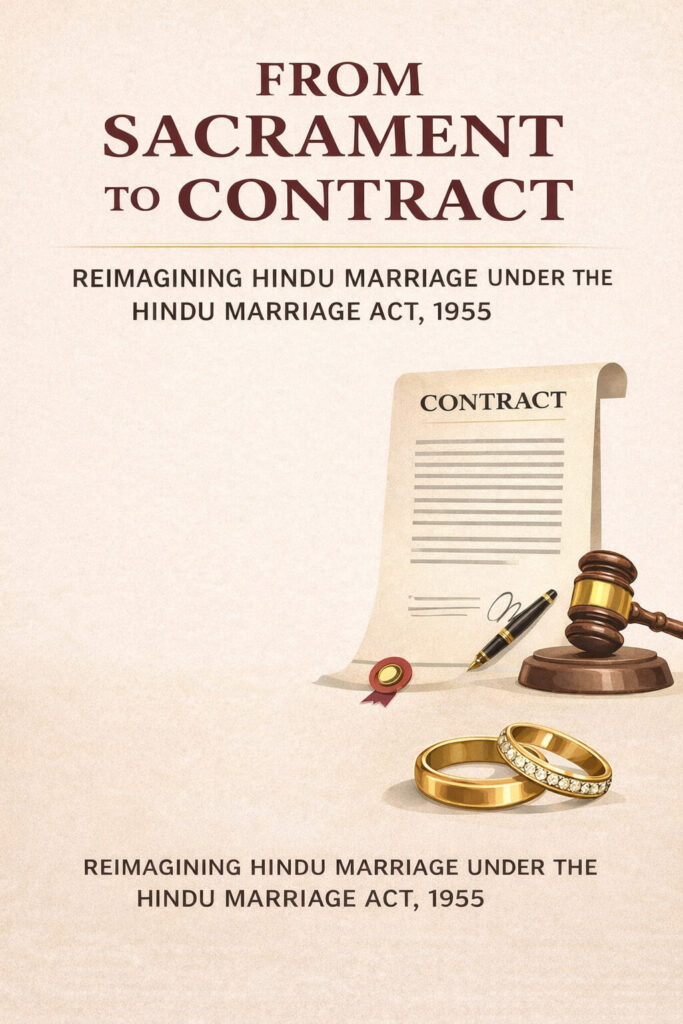
TRADITIONAL NATURE OF HINDU MARRIAGE: A SACRAMENT
Hinduism, beyond being an ancient religion, offers a comprehensive guide to leading a holistic and fulfilling life. For the pursuance of the same, it provides for sixteen Sanskaras, outlining the various vital phases of life. Out of these sixteen Sanskaras, Vivah Sanskara is enumerated as the twelfth stage of life, and considerable importance has been attached to the same. Henceforth, Hinduism attaches spiritual and theological connotations to the ceremony of marriage and provides a religious backing for it. Marriage, being a sacrament under Hindu law, cannot be dissolved and is considered complete only with the performance of certain ceremonies.[1]
But with the evolution of society, divorce has become a common feature in society and also among the Hindus, dissolving the essence of permanency that existed in marriage. With the introduction of the Hindu Marriage Act, 1955, Hindu law was codified, and provisions for divorce were introduced. However, the importance of ceremonies in the act of marriage was preserved under Section 7 of the HMA, 1955.[2] The court reiterated this in the case of Dolly Rani v Manish Chaudhry as recently as 2025.[3] It is stipulated that the ceremony of Saptapadi, performed in front of a Vivah Homa, is necessary for the conclusion of a marriage under Hindu law. This provides us with an answer to a very integral question: that Hindu Marriage is still a sacrament and not a social contract.
THE SHIFT UNDER THE HINDU MARRIAGE ACT, 1955: CONTRACTUAL ELEMENTS
The Hindu Marriage Act, 1955, marked a significant change in the legal status attached to the Hindu marriage concept by introducing features that are somewhat analogous to the approach of a civil contract. For example, Section 5 establishes specific conditions that are acceptable for a marriage to be valid; among those conditions are monogamy, minimum marriageable age, and, most significantly, the free consent of both parties.[4] Generally speaking, the earlier position primarily relied on marriages being arranged, and consent (very often women’s consent) only being considered secondary.
The most significant change came from Section 13, which recognised divorce.[5] By allowing divorce on specified grounds of cruelty, desertion, adultery, or conversion, the Hindu law embraced marriage as being possibly dissolvable. The recognition of divorce in Hindu law indicates the legislature’s acknowledgement that marriage is not unbreakable. Further, it exemplifies a more contract-style approach; if the terms are breached, then the parties can be released. In addition, Sections 11 and 12 address void and voidable marriages, aligning them with the principles of contract law.[6]
The marriage can be voided for reasons such as fraud, coercion, or incapacity, which are similar concepts that explain how contracts are invalidated. Lastly, Section 9, Restitution of Conjugal Rights, allows a spouse to compel the other spouse to return to cohabiting with them legally, and it can also be seen to mirror the enforcement of contracts.[7]
CRITICAL EVALUATION: PROS, CONS & SOCIETAL IMPACT
The transition from a completely sacramental contract to a contractual marriage has altered individuals and societies in Hindu communities.
First, the most obvious benefit is that there are legal options out of abusive or exploitative marriages. Within the sacramental definition, marriage was understood as a permanent situation and, especially for women, could leave the individual vulnerable to harm or neglect. The Hindu Marriage Act, 1955, introduced divorce, where the parties to the marriage could choose to prioritise dignity and safety over social pressures.[8] Statutory maintenance and alimony obligations can enable women to achieve economic security and independence.[9] Marriage could be framed in partnership with fairness and dignity instead of unquestioned, unworshipped patriarchy. Additionally, the law now takes into account personal autonomy and individual choice, as substantiated in case law, as one of the central aspects of the Article 21 right to life and personal liberty; autonomy in selecting a partner is an example.[10] This has been a remarkable move away from family-based choices.
From the other side, various possible points may be regarded as having negative connotations. The codification of Hindu marriage through the HMA, 1955, removed the sacramental character from marriage, converting an eternal bond of spirit into an ephemeral civil contract.[11] Consequently, there has been a dramatic increase in divorces, increased misuse of cruelty provisions for financial gain, the collapse of joint families, and a demographic crisis with Hindu fertility falling below the replacement level in urban Uttar Pradesh and beyond.[12]
What was once a divine union of dharma across generations is now a transactional association, and this is hastening the dissolution of the Hindu civilizational identity and its associated value systems, while adding to the volume of broken households, ignored and abandoned elders, and a generation of men who have turned against marriage itself.[13]
The Hindu Marriage Act of 1955 transformed Hindu marriage from an indissoluble sacrament into a civil contract that can be dissolved, resulting in lasting social harm in Uttar Pradesh. Since the year 2000, urban divorce in the Lucknow–Kanpur–Noida belt has increased by 400%–600%, disrupting joint families and reducing the Hindu Total Fertility Rate (TFR) to 1.4–1.6 births per woman in Gautam Buddh Nagar and Ghaziabad, which is far below replacement levels.[14] Broadly defined cruelty grounds (s 13(1)(ia)) and maintenance overlap have created extortionist courts, contributing to a male suicide rate in UP of 28 per 100,000 and creating a “marriage strike” amongst young men in western UP.[15] Sacred rites such as saptapadi are meaningless theatre if such bonds can dissolve for ₹500 or through the Supreme Court’s irretrievable breakdown doctrine.[16] The consequences have created a disconnected individualism, eroded intergenerational security, and a Hindu civilisation that is sleepwalking towards demographic disappearance.
CONCLUSION
The Hindu Marriage Act of 1955 represents a unique blend of tradition and modernity, while preserving the sacramental essence of Hindu marriage through the compulsory observance of rituals, such as saptapadi under Section 7(1), and establishing safeguards for contractual protections in response to societal changes. The Act’s preservation of conditions of validity (s 5), grounds for dissolution (s 13), and remedies of restitution of conjugal rights (s 9) and maintenance has strengthened the freedom of individuals, protected vulnerable spouses, and created legal recourse to circumstances that were not available in a purely sacramental structure.[17] These reforms have promoted gender equality, women’s independence, and recognition of individual choice within the framework of Article 21 of the Constitution of India, as well as in Uttar Pradesh and across India.[18] Essentially, the legislation strikes an appropriate balance, upholding the sanctity of vivaha as stated in recent judicial pronouncements, while bringing a historical institution into line with everyday realities, ensuring that Hindu marriage is both a spiritual ceremony and a just partnership in an evolving social order.[19]
Author’s Name: Ananya Sharma (Dr Ram Manohar Lohiya National Law University, Lucknow)
[1] Paras Diwan, Family Law in India (10th edn, Allahabad Law Agency 2022).
[2] The Hindu Marriage Act 1955, s 7.
[3] Dolly Rani v Manish Chaudhry [2025] SCC OnLine SC 411.
[4] The Hindu Marriage Act 1955, s 5.
[5] Ibid s 13.
[6] Ibid Ss 11-12.
[7] Ibid s 9.
[8] n [5].
[9] Ibid s 25.
[10] Shafin Jahan v Asokan K M (2018) 16 SCC 368.
[11] Tahir Mahmood, Principles of Hindu Law (6th edn, Universal Law Publishing 2020).
[12] Government of India, Ministry of Health and Family Welfare, National Family Health Survey (NFHS-5) (2021).
[13] ibid.
[14] Registrar General of India, Vital Statistics of India Based on Civil Registration System 2023 (GOI 2024).
[15] National Crime Records Bureau, Accidental Deaths and Suicides in India 2023 (NCRB 2024).
[16] Naveen Kohli v Neelu Kohli (2006) 4 SCC 558.
[17] The Hindu Marriage Act 1955, ss 5, 7, 9, 13.
[18] Lata Singh v State of Uttar Pradesh (2006) 5 SCC 475.
[19] Dolly Rani v Manish Chaudhry [2025] SCC OnLine SC 411.
