
INTRODUCTION
Since its enactment in 2016, the Insolvency and Bankruptcy Code (IBC)[1] has served as one of the crucial pieces of legislation for justice towards the economy. The enactment of the IBC has totally changed the narrative of the Indian Corporate Ecosystem. Prior to that, disputes related to Insolvency were scattered in various fields like the SARFAESI Act 2002, Companies Act 2013, Sick Industrial Companies (Special Provisions) Act 1985 (SICA), etc. Due to which parties had to suffer from delayed decisions, depreciation of the Company’s Value, and excessive uncertainty. Whereas the IBC ensures a strict time-bound and centralised framework that has turned into a boon for the insolvency regime.
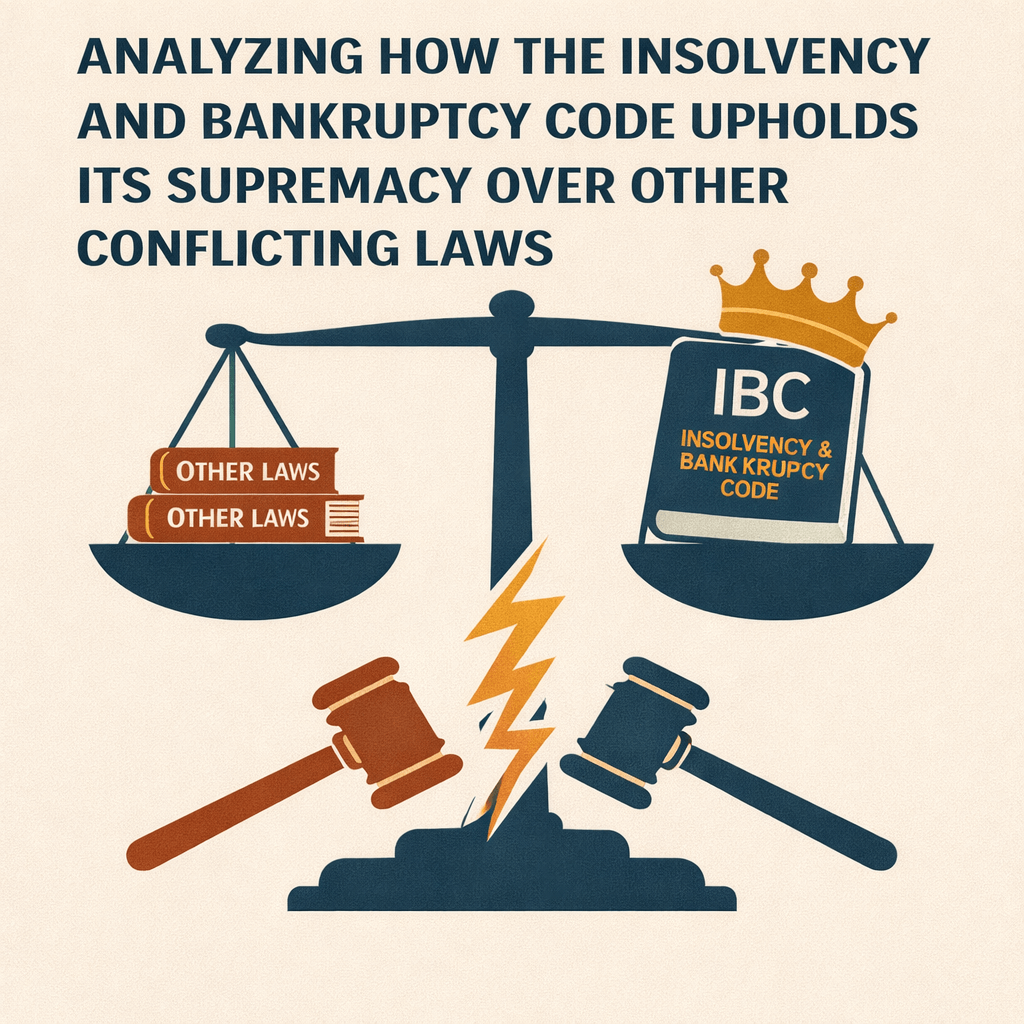
Over the years, the potential clash between IBC and other existing laws has remained in question. These clashes range from sectoral clashes to tax-related or contractual in nature. However, continuously, the Judiciary has established the Supremacy of IBC over other special Laws when it comes to any conflict. The Judiciary has made regular emphasis on provisions like Section 238[2] (Overriding Effect), Section 14[3] (Moratorium), and Section 31[4] (Binding Resolution Plan), to strengthen the supremacy of IBC.
SECTION 238: FOUNDATIONAL SUPREMACY OF IBC
Section 238[5] of the IBC contains a significant demarcation of upholding the supremacy of the code. The provision clearly states that, “the provision of the code shall have effect notwithstanding anything inconsistent contained in any other law”. In other words, in case of any inconsistency/clash between two or more laws, IBC shall prevail. Thereby strengthening the foundational supremacy of the IBC.
In the case of M/S Innoventive Industries v ICICI Bank[6], the court backed the objective behind enacting IBC and stated that the existing legislations are insufficient in resolving Insolvency disputes, thereby reiterating that “in case of any discrepancy, IBC shall prevail”.
Later, in the case of Duncans Industries Ltd. v A.J. Agrochem[7], the Insolvency and Bankruptcy Code, 2016 & the Tea Act, 1953 were in question. While both contain the non-obstante clauses, the court upheld that “IBC shall prevail because the later enacted legislation shall have an overriding effect over the previously enacted legislation”.
Over the years, the judiciary has served a vital role in strengthening the spirit of IBC, thereby assuring time-bound and specialised decisions for the cases falling under IBC.
HOW THE CLEAN SLATE PRINCIPLE UPHOLDS THE SUPREMACY OF IBC?
Section 31[8] of the IBC talks about the “binding nature” of a resolution plan. As per Section 31, once the resolution plan is passed by the National Company Law Tribunal (NCLT), it becomes binding on all the stakeholders, creditors, employees, and even the government authorities. No further claims can be made once the resolution plan has been passed. Parallelly, the main essence of this provision lies in protecting the value of the Corporate Debtor while safeguarding the authenticity of the IBC.
The Clean Slate Principle has emerged from this statutory provision and claims that the corporate debtor will be free from all the past dues, liabilities, penalties, etc, that are not covered under the passed Resolution Plan, thereby cementing the objective of IBC.
In the case of Ghanashyam Mishra and Sons Private v Edelweiss Asset Reconstruction Company Pvt. Ltd[9]., the court held that if the authorities were allowed to enforce past claims, it would frustrate the entire purpose of the resolution; therefore, once the Resolution Plan has been passed, no other claims against the Corporate Debtor can be made.
The principle was further strengthened by the court in the case of JSW Steel Ltd. v Pratishtha Thakur Haritwal[10], where the court not only warned the authorities for making continuing claims that are not covered under the Resolution Plan but also held that such action would attract “Contempt of Court.”
This statutory provision provides a sense of relief to the Resolution Applicants while assuring distressed companies of smooth capital inflows.
HOW SECTION 14 FREEZES COMPETING CLAIMS?
Section 238[11] of the IBC provides for explicit overriding powers; on the other hand, it is Section 14[12] that operationalises it during insolvency proceedings. As per Section 14[13] of the IBC, a Moratorium has been imposed on the Corporate Debtor from the date on which the National Company Law Tribunal (NCLT) admits an Insolvency Application. It works as a statutory halt that provides a “breathing room” for the Corporate Debtor while barricading any parallel proceedings. The essence of this provision is to provide a healthy environment to the Resolution Professional so that he/she can manage Company Affairs effectively. Section 14[14] prohibits various actions, which are:
- Initiating any Parallel Legal Proceedings.
- Transfer/Sale of Assets.
- Enforcement of Security Interests.
In the case of Bharti Airtel Limited v Vijay Kumar[15], the legal issue revolved around whether the Insolvency Set-off is available during the CIRP process or whether Section 14[16] excludes it. The court held that allowing any Insolvency Set Off during the proceedings would harm the protective intent behind imposing Moratorium, thereby clarifying the creditor’s rights during resolution proceedings.
Undoubtedly, the statutory provision safeguards the corporate debtor from any malicious activities of the creditors, while ensuring the smooth functioning of the proceedings and providing a safe space for the Resolution Professional to conduct Company Affairs effectively.
INTERSECTION BETWEEN IBC AND ARBITRATION PROCEEDINGS
The conjunction between IBC[17] and Arbitration[18] has been a recurring area of conflict over the years. Arbitration focuses on Party Autonomy, whereas IBC[19] focuses mainly on the benefit of all by resolving the Corporate Debtor’s Debt and distributing its assets equitably. The first and foremost intersection between IBC and Arbitration[20] lies in Section 14[21] of the IBC, where once the Insolvency Application has been accepted by the NCLT, all proceedings, including Arbitration, are put on a stay. Additionally, the overriding powers of IBC, such as Section 238[22] of the IBC, work as a volatile fuel in establishing the Supremacy of IBC.
In the case of Alchemist Asset Reconstruction Company Ltd. v Hotel Gaudavan[23], the court held that, “Any arbitration proceeding initiated after imposition of moratorium under Section 14 of the Insolvency and Bankruptcy Code, 2016 is non-est in law. Additionally, in the case of Jindal Lifestyle Ltd. v Satyendra Sharma[24], the court clarified that, when the insolvency proceedings are in motion, an isolated Arbitral Award, halting the insolvency proceedings, cannot be awarded. The court further emphasised that such an act of passing an isolating Arbitral Award would disrupt the resolution process and would be violative of Section 14[25] of the IBC, which talks about Moratorium.
The Judiciary has maintained the balance between Arbitration[26] and IBC[27] very meticulously. It strengthens the fact that the Insolvency and Bankruptcy Laws are not just about barricading rights but regulating how and when they can be exercised.
CONCLUSION
The Insolvency and Bankruptcy Code, 2016, showcased a paradigm shift towards the approach of India in handling matters pertaining to Insolvency and Bankruptcy. Traditionally, the approach was more inclined towards Recovery of Dues, but the modern approach focuses more on Revival of Distressed companies, maximising value, protecting jobs, and safeguarding the economy.
The Supremacy of IBC has been secured through Section 238[28] (overriding effect), operationalised by Section 14[29] (Moratorium), and cemented by Section 31[30] (Binding nature of Resolution Plan), repeatedly over the years by the Judiciary.
By consistently strengthening the supremacy of the IBC, the courts have created an investor-friendly and credible interface to uplift the Corporate Structure. Parallelly, the self-sufficient nature of IBC serves not just as an ordinary law but as a cornerstone of India’s economic stability.
Author’s Name: Ashi Singhal ( IMS Unison University, Dehradun)
[1] Insolvency and Bankruptcy Code 2016.
[2] Insolvency and Bankruptcy Code 2016, s 238.
[3] Insolvency ad Bankruptcy Code 2016, s 14.
[4] Insolvency and Bankruptcy Code 2016, s 31.
[5] Insolvency and Bankruptcy Code 2016, s 238.
[6] M/S Innoventive Industries v ICICI Bank 2018 (1) SCC 407.
[7] Duncans Industries Limited v AJ Agrochem, AIR 2019 SC 5472.
[8] Insolvency and Bankruptcy Law 2016 s 31.
[9] Ghanashyam Mishra and Sons. Private v Edelweiss Asset Reconstruction Company Private Ltd 2021 SCC Online SC 313.
[10] JSW Steel Limited v Pratishtha Thakur Haritwal 2025 INSC 401.
[11] Insolvency and Bankruptcy Code 2016, s 238.
[12] Insolvency and Bankruptcy Code 2016, s 14.
[13] Insolvency and Bankruptcy Code 2016, s 14.
[14] Insolvency and Bankruptcy Code 2016, s 14.
[15] Bharti Airtel Limited v Vijay Kumar, 2024 INSC 15.
[16] Insolvency and Bankruptcy Code 2016, s 14.
[17] Insolvency and Bankruptcy Code 2016.
[18] Arbitration and Conciliation Act 1996.
[19] Insolvency and Bankruptcy Code 2016.
[20] Arbitration and Conciliation Act 1996.
[21] Insolvency and Bankruptcy Code 2016, s 14.
[22] Insolvency and Bankruptcy Code 2016, s 238.
[23] Alchemist Asset Reconstruction Company Limited v Hotel Gaudavan, 2017 SCC OnLine SC 1362.
[24] Jindal Lifestyle Limited v Satyendra Sharma, Company Appeal (AT) (INS) – 1180/2024 (August 21, 2025).
[25] Insolvency and Bankruptcy Code 2016, s 14.
[26] Arbitration and Conciliation Act 1996.
[27] Insolvency and Bankruptcy Code 2016.
[28] Insolvency and Bankruptcy Law, s 238.
[29] Insolvency and Bankruptcy Law, s 14.
[30] Insolvency and Bankruptcy Law, s 31.
