
INTRODUCTION
The global legal and commercial landscape governing the use of an individual’s name, image, and likeness (NIL) has undergone transformative changes in recent years. Traditionally confined to celebrity endorsement and sports merchandising, NIL rights have now become a central topic in the conversations about athlete rights, digital identity, and influencer regulation. The legal recognition of these rights emerges from the understanding that personal identity has tangible commercial value and warrants legal protection. The shift is not only regulatory but also philosophical in nature, which is an acknowledgement that exploitation of one’s persona without consent infringes principles of autonomy, privacy, and dignity.[1]
While much of the recent momentum originated in the United States, where student-athletes are now allowed to profit from their NIL, the ripple effects are global. Countries like India, the UAE, and the United Kingdom are now discussing frameworks that reconcile commercial freedom with safeguards against abuse.[2]
THE CONCEPT OF NIL RIGHTS
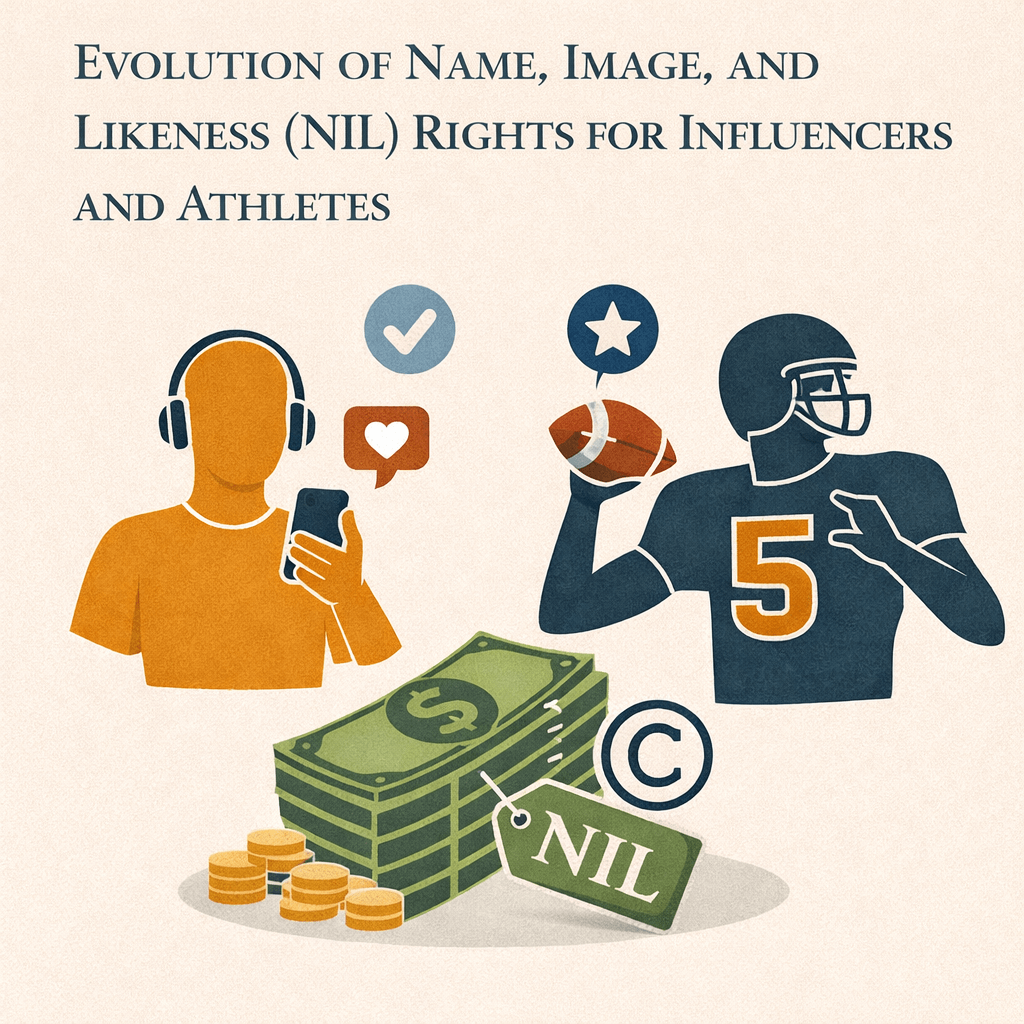
NIL rights refer to the legal ability of individuals, including athletes, entertainers, or social media influencers, to control and monetise their personal identifiers, such as their name, signature, image, voice, and likeness. These rights uphold and defend a core principle: one’s personal identity cannot be used commercially without authorisation.[3]
Legally, NIL rights operate at the intersection of intellectual property, contract, and privacy law. They embody elements of the right to publicity, which is a part of tort law recognised in countries like the United States and the right to privacy or personality rights, increasingly recognised under constitutional and data protection frameworks globally.
THE AMERICAN CATALYST: NCAA’S NIL REVOLUTION
The modern NIL revolution began on 1 July 2021, when the U.S. National Collegiate Athletic Association (NCAA) adopted its interim NIL policy following the Supreme Court’s decision in NCAA v Alston. This ruling dismantled the NCAA’s near-monopoly on athlete compensation, recognising that college athletes could benefit financially from their NIL without forfeiting eligibility.
In 2025, the introduction of the Student Athlete Fairness Enforcement (SAFE) Act revealed a new frontier. The Act seeks to replace the patchwork of state laws with a federal regime that sets nationwide standards for NIL contracts, revenue-sharing in collegiate sports, and protection against exploitative agents.[4] This development marks a decisive step toward balancing commercialisation with fairness, particularly for women’s and Olympic sports.
The SAFE Act also brings into focus the fiduciary duties of schools and sponsors, raising questions about collective management of media rights and equitable profit distribution. These issues mirror earlier evolutions in copyright and broadcasting law, demonstrating how NIL rights are an inevitable extension of existing intellectual property norms rather than a novel right in isolation.
GLOBAL OUTLOOK TOWARDS THE NIL RIGHTS
While the U.S. has legislated aggressively in favour of athlete monetisation, the international legal environment remains fragmented.
In India, there is no dedicated NIL legislation. However, Indian athletes and influencers rely on a mixture of privacy rights under Article 21 of the Constitution, contract law, and tort claims for misappropriation of identity. The Supreme Court of India in R Rajagopal v State of Tamil Nadu (1994) recognised a limited right of privacy that indirectly supports NIL claims. Coupled with the Digital Personal Data Protection Act, 2023, India’s trajectory hints at a convergence between data privacy and NIL protection.[5]
Most Indian NIL agreements today are based on contracts. These contracts typically specify scope, compensation, territory, moral rights, and dispute resolution mechanisms. Industry standards increasingly demand inclusion of clauses related to exclusivity, reputational harm, and moral conduct.[6]
In the UAE, NIL regulation is integrated within broader sports and media laws, emphasising compliance obligations for athletes and sponsors.[7] This contrasts with Western models that prioritize monetization. Instead, the UAE framework aims to uphold public morality and protect both athletes and sponsors from reputational and branding conflicts.
NIL FOR INFLUENCERS: THE DIGITAL DIMENSION
The NIL conversation, originally confined to college athletes, has expanded to cover social media influencers. In the digital economy, one’s username, digital avatar, or even meme representation can carry immense value. TikTok stars and content creators now sign multi-brand NIL deals similar to the sponsorship models of professional athletes.[8]
However, influencer NIL rights face unique contractual and regulatory challenges. Content made using artificial intelligence, such as deepfakes or AI-generated avatars, raises some questions:
- Who owns the likeness of an AI-generated version of a celebrity or influencer?
- Can consent be presumed for algorithmic reproductions based on publicly available content?
Courts and regulators are now starting to deal with these grey areas. The European Union’s AI Act (2024)[9] and India’s forthcoming Digital Policy on Synthetic Media[10] both propose liability frameworks making platforms accountable for unauthorised NIL uses in AI-generated content. These things reflect that NIL rights are no longer limited to bodily likeness but further extend to digital identities and virtual representations.
CONTRACTS AND DISPUTE MANAGEMENT
The licensing contract lies at the core of NIL transactions. A well-drafted NIL agreement defines the extent to which a brand may use an individual’s likeness and under what conditions. Some of the important points include:
Scope of Rights: Whether the license is exclusive or non-exclusive, the license should cover specific media like social platforms, merchandise, or events.
Compensation Models: Fixed fees, royalties, or performance-based remuneration models are common. Athletes with substantial followings often negotiate hybrid payment systems combining upfront compensation with revenue shares.
Moral and Image Protection: Inclusion of clauses for preventing misuse or misrepresentation of the athlete’s image safeguards integrity and brand value.
Dispute Resolution: Arbitration is increasingly preferred, especially in multi-jurisdictional contracts involving athletes or influencers across countries.[11]
The most common disputes involve moral breaches or unapproved content, where influencer conduct adversely affects the brand’s reputation. Sometimes, athletes allege exploitative contract terms or underpayment, which is an increasing trend.
TAXATION AND COMPLIANCE DIMENSIONS
Taxation remains a complex, under-addressed dimension of NIL rights. For U.S. student-athletes, NIL income is taxable under Internal Revenue Code §61, often complicated by multi-state endorsements. Similarly, under Indian law, NIL income qualifies as “professional receipts” under Section 28 of the Income Tax Act, 1961. With the 2025 Income Tax Bill proposing new TDS provisions abolishing NIL certificates, compliance obligations for content creators and athletes have increased.[12]
Transparency in NIL contracts is no longer optional. Many jurisdictions now require disclosure of NIL payments to prevent hidden sponsorships and money laundering. In India, the Advertising Standards Council’s 2021 Guidelines for Influencer Advertising already mandate such disclosures, emphasising authenticity and consumer protection.[13]
GENDER INCLUSIVITY AND ETHICAL CONSIDERATIONS
The NIL era also surfaces profound questions about gender equity and diversity. Historically, women athletes earned only fractions of their male counterparts. NIL opportunities, driven by social media metrics rather than institutional hierarchies, have significantly narrowed this gap. Female athletes in professional sports now often demand higher NIL valuations due to robust engagement and personal branding.[14] However, this newfound empowerment comes with risks—over-commercialisation of personal lives, data exploitation, and invasive contracts that blur professional and private boundaries. Ethical frameworks must ensure NIL rights do not commodify identity to the extent of compromising personal autonomy.
WHAT’S NEXT IN STORE FOR NIL?
The future of NIL rights points toward harmonisation and expansion. The trend reveals three key directions:
Codification of NIL Rights: More countries are likely to enact explicit NIL statutes, integrating privacy, contract, and consumer law principles.
AI and Metaverse Integration: The next challenge lies in regulating NIL in virtual universes where digital avatars and holographic likenesses can generate limitless derivative uses.
International Licensing Protocols: With cross-border NIL activations becoming common, treaty-based frameworks similar to the Berne Convention may emerge.
For India and similar jurisdictions, establishing statutory clarity on NIL rights is essential. This would also bring India in line with international practices, paving the way for a structured NIL economy.
CONCLUSION
The evolution of NIL rights signifies a major shift in perspective from ownership of talent to ownership of identity. For athletes and influencers, these rights represent economic empowerment, yet they bring complex legal responsibilities. The future of NIL law will largely depend on balancing autonomy with accountability, privacy with profit, and innovation with integrity.
As countries worldwide move toward codifying personality-based economic rights, NIL regulation may become the defining feature of modern entertainment and sports law. Its success will depend on crafting fair, transparent, and equitable systems that protect identity as property.
Author’s Name: Priyam Pratik (Faculty of Law, Allahabad University)
[1] NCAA v Alston 594 U.S. 69 (2021).
[2] LawSikho, ‘How to Navigate NIL in Sports Law’ (June 2025);https://lawsikho.com/blog/how-to-navigate-nil-in-sports-law/.
[3] IADC, The Evolution and Challenges of Name, Image, and Likeness (NIL) (2024); https://www.iadclaw.org/assets/1/6/20.0_The_Evolution_and_Challenges_of_Name,_Image,_and_Likeness_(NIL).
[4] USA Today, ‘Senators Introduce SAFE Act for College Athletes’ (29 September 2025); https://www.usatoday.com/story/sports/college/2025/09/29/senators-introduce-safe-act-for-college-athletes-nil-rights-womens-sports-sports-broadcasting-act/86428219007/.
[5] LawSikho, ‘How to Navigate NIL in Sports Law’ (June 2025);https://lawsikho.com/blog/how-to-navigate-nil-in-sports-law/
[6] KS Legal, ‘NIL Agreements: What Student-Athletes Need to Know’ (September 2025); https://kslegal.com/nil-agreements-what-student-athletes-need-to-know-in-rapidly-changing-world-of-college-sports/.
[7] LawInSport, ‘How the UAE Regulates NIL Rights for Athletes’ (2024); https://www.lawinsport.com/topics/item/how-the-uae-regulates-name-image-likeness-nil-rights-for-athletes.
[8] EntertainmentLaw Miami, ‘How NIL Deals Are Changing Athlete Contracts in 2025’ (May 2025); https://entertainmentlawyermiami.com/how-nil-deals-are-changing-athlete-contracts-in-2025/.
[9] EU Artificial Intelligence Act (2024); https://eur-lex.europa.eu/legal-content/EN/TXT/?uri=CELEX:32024R1689.
[10] TheIndianEXPRESS, ‘As India looks to mandate AI content labelling, examining the growing menace of deepfakes’; https://indianexpress.com/article/explained/explained-sci-tech/india-ai-content-social-media-labelling-deepfakes-10322107/.
[11] LawSikho, ‘How to Navigate NIL in Sports Law’ (June 2025); https://lawsikho.com/blog/how-to-navigate-nil-in-sports-law/.
[12] Economic Times, ‘New Tax Bill 2025’ (11 October 2025); https://economictimes.indiatimes.com/wealth/tax/new-tax-bill-2025-no-nil-tds-certificate-for-all-taxpayers-including-nris-what-does-it-mean-for-indians-and-nris/articleshow/120481080.cms.
[13] ASCI, ‘Guidelines for Influencer Advertiding’ (2021); https://www.ascionline.in/wp-content/uploads/2023/08/GUIDELINES-FOR-INFLUENCER-ADVERTISING-IN-DIGITAL-MEDIA.pdf.
[14] AFS Law, ‘Top Legal Challenges for the Sports Industry 2025’ (April 2025); https://www.afslaw.com/perspectives/alerts/top-10-legal-challenges-the-sports-industry-2025.
